
Blockchain innovation has unlocked new financial systems—but it has also exposed a major bottleneck: slow transaction speeds and rising gas fees on networks like Ethereum. This guide delivers a clear layer-2 scaling solutions overview, explaining how these technologies ease congestion and dramatically reduce costs. We break down how Layer-2s work, the different types available, and why they are critical for faster, more affordable decentralized applications. Our insights are grounded in years of tracking crypto trends and emerging blockchain ecosystems, giving you practical, actionable knowledge to confidently navigate and evaluate the next wave of scalable blockchain infrastructure.
The Core Bottleneck: Why Base-Layer Blockchains Struggle to Scale
At first, I underestimated the Blockchain Trilemma—the idea that blockchains must balance decentralization (no central control), security (resistance to attacks), and scalability (handling many transactions quickly). I assumed networks could simply “upgrade” their way out of congestion. However, reality hit during a market surge.
As demand spiked, Layer-1 fees soared. Think of a base-layer blockchain as a single-lane highway at rush hour. There’s only so much room. When too many cars enter, drivers start bidding for space. On-chain, that bidding war shows up as higher gas fees. In 2021, Ethereum fees averaged over $50 during peak periods (YCharts), pricing out everyday users.
Initially, I blamed user hype. Yet the deeper issue was throughput limits baked into protocol design. Consequently, scaling isn’t optional—it’s survival. Without improvements and a clear layer-2 scaling solutions overview, mainstream adoption stalls. The lesson? Infrastructure must evolve before mass demand arrives, not after.
Defining Layer-2: How Processing Transactions Off-Chain Works
A Layer-2 (L2) is a protocol built on top of a Layer-1 blockchain (like Ethereum). It inherits the base chain’s security but processes transactions separately to reduce congestion. Think of it as an express lane on a packed highway (because no one enjoys rush-hour gas fees).
The Rollup Strategy
Most L2s use rollups, which bundle hundreds of transactions into one compressed package before submitting it to the main chain. Instead of recording every action individually, the Layer-1 stores a summary plus cryptographic proof. If you want deeper context, review how consensus algorithms shape blockchain performance: https://ftasiamanagement.com.co/how-consensus-algorithms-shape-blockchain-performance/.
This layer-2 scaling solutions overview wouldn’t be complete without the key benefits:
- Lower fees
- Faster confirmations
- Smoother user experience
Some critics argue L2s add complexity. True—but the tradeoff is worth it. Recommendation: start with established rollups securing billions in total value locked (TVL) (L2Beat, 2024). Security first, experimentation second.
A Comparative Look at Leading L2 Technologies
If you’ve spent any time navigating Ethereum gas fees during peak NFT mints or DeFi launches, you already know why Layer 2 (L2) solutions matter. This layer-2 scaling solutions overview breaks down the leading approaches shaping today’s ecosystem.
Optimistic Rollups (Arbitrum, Optimism)
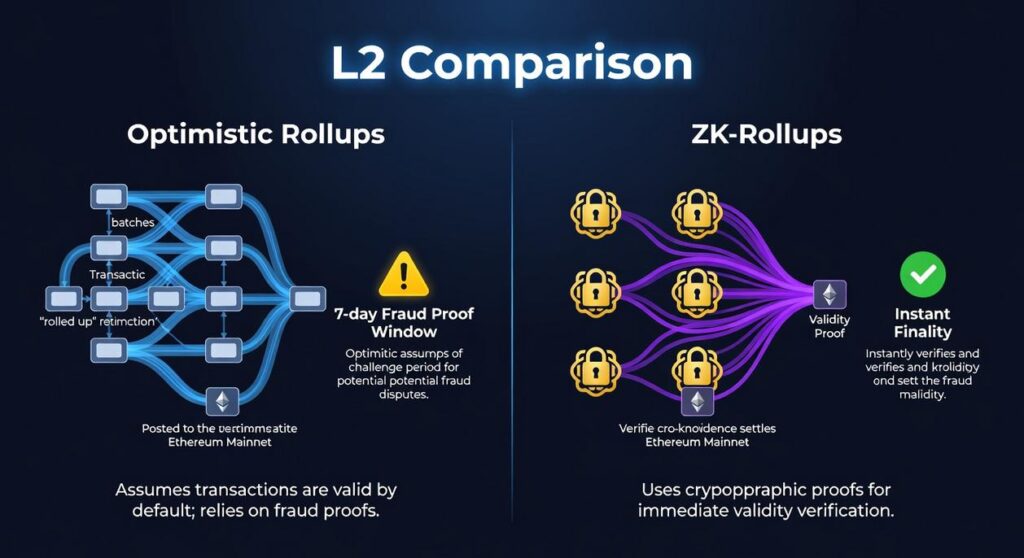
Optimistic Rollups operate on an “innocent until proven guilty” model. Transactions are bundled off-chain and posted to Ethereum, assumed valid unless someone submits a fraud proof during a challenge window (typically about seven days). A fraud proof is evidence that a submitted transaction batch contains invalid data.
This design balances speed and security. Users get lower fees and higher throughput, while Ethereum still acts as the final judge. Critics argue that the withdrawal delay is inconvenient (and yes, waiting a week can feel like dial-up internet in a fiber world). However, in practice, liquidity providers often bridge funds instantly for a small fee.
In Asia’s fast-moving GameFi markets, where traders rotate capital quickly, this trade-off between cost and delay is a constant consideration.
Zero-Knowledge (ZK) Rollups (zkSync, StarkNet)
ZK Rollups take a different route. Instead of waiting for disputes, they generate validity proofs—cryptographic evidence that mathematically confirms every transaction in a batch is correct. These proofs rely on advanced techniques like zk-SNARKs or zk-STARKs.
The result? Faster finality and stronger security guarantees. Funds can typically be withdrawn more quickly because validity is proven upfront. Some skeptics argue ZK systems are too complex and harder for developers to build on. That’s fair—tooling has historically lagged. But rapid ecosystem growth suggests that barrier is shrinking.
In regions like Singapore and Seoul, where institutional blockchain pilots are expanding, ZK’s cryptographic assurances often appeal to compliance-minded stakeholders.
Sidechains (Polygon PoS)
Sidechains are independent blockchains connected to Ethereum via a two-way bridge. They use their own consensus mechanisms (for example, Proof of Stake validators).
This offers high scalability and low fees. However, security depends on the sidechain’s validator set—not Ethereum itself. Some purists argue this weakens decentralization. Others counter that for many retail applications, practical scalability outweighs theoretical risk.
State Channels
State channels allow users to transact off-chain multiple times and settle only the final state on-chain. They’re ideal for high-frequency interactions between fixed participants—think blockchain-based games or recurring micropayments.
Pro tip: For niche gaming guilds or esports wagering platforms, state channels can dramatically cut transaction costs while maintaining cryptographic assurance.
From Theory to Practice: Popular L2 Ecosystems and Their Use Cases
Layer 2 (L2) networks are blockchains built on top of Ethereum to process transactions faster and cheaper. If Ethereum is the highway, L2s are express lanes.
The DeFi Revolution on L2s
Platforms like Arbitrum and Optimism let decentralized exchanges (DEXs—peer-to-peer trading platforms) and lending protocols run with fees that are often 90%+ lower than Ethereum mainnet (L2Beat data). Critics argue mainnet is more secure. Fair point. But for everyday traders, LOW FEES and speed often matter more than theoretical purity.
NFTs and Gaming Find a Home
Minting NFTs or playing blockchain games on L2s costs cents, not $50 gas spikes (remember 2021?). That accessibility changes adoption curves fast.
Token Investment Insights
Which L2 a project uses shapes user growth, liquidity, and long-term upside. A proper layer-2 scaling solutions overview should be part of any token analysis.
Wallet Integration
• Add the L2 network in MetaMask
• Bridge assets
• Start transacting
What’s next? Compare ecosystems, track developer activity, and watch where users migrate.
Navigating the Future of Scalable Blockchains
You came here for a clear layer-2 scaling solutions overview, and now you understand how these innovations are transforming blockchain performance. The frustration of high gas fees and painfully slow confirmations has long limited real-world adoption. Today, that bottleneck is being removed. By shifting execution to a second layer while preserving main-chain security, Layer-2 protocols unlock the speed and affordability users and developers demand.
Don’t let outdated infrastructure hold you back. Explore leading L2 ecosystems, set up a secure wallet, and position yourself early. Take action now and start participating in the next wave of scalable blockchain growth.